
St Anthony Of Padua, Austral
In June 2026, Gutteridge Pipe Organs was commissioned by the Catholic Church of St Anthony Of Padua in Austral to relocate the 1970 Roger Pogson 2 manual instrument from ST Luke's Anglican Church, Liverpool.
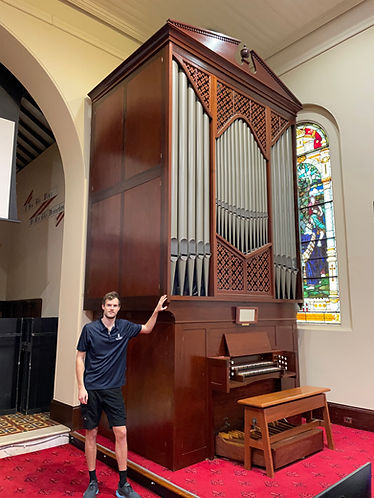
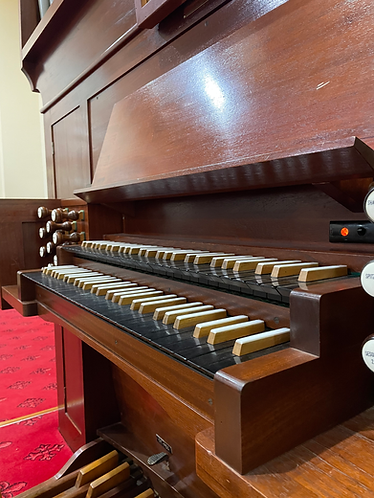
Having provided reliable service to the parish of St Luke's for over half a century, the recent lack of use and upcoming structural works in the church meant that this wonderful two manual instrument needed a new home.
The Church of St Anthony wasted no time in grasping the opportunity and they called upon the the services of Gutteridge Pipe Organs to carry out the project.
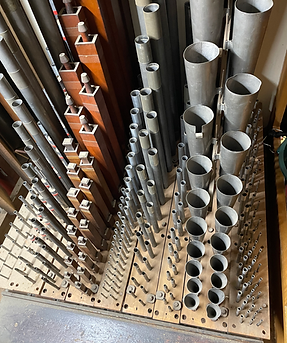
Week 1 on-site at St Lukes Liverpool
With the Church structural works imminent, we got started on this project right away. After a pre dismantling assessment was carried out where any issues were documented, we got underway with the removal of the Great and Pedal pipework. With improved access due to the absence of the pipes, we spent the following two days disconnecting the mechanical linkages between the console and the various divisions of the instrument, with almost every part being unique this requires very strategic labelling to ensure every component goes back in to its rightful place.
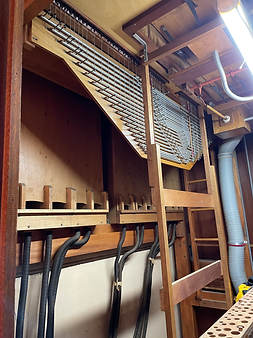
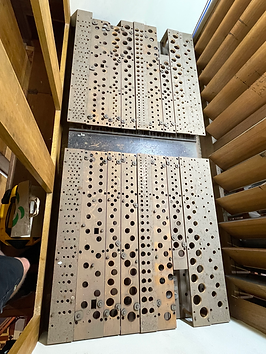
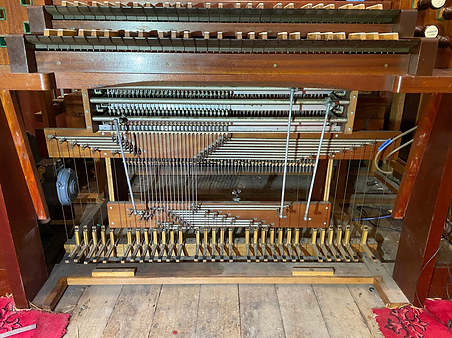
Once all the mechanical action was removed we moved up top to the swell box where we had more than 700 pipes to remove and carefully store ready for their transport to Austral. With all the pipe work now removed, the focus shifted to lightening the swell soundboard as much as practically possible, to aid with its removal from its position almost 4 meters up in the organ.
Week 2 on-site at St Lukes Liverpool
A new week seen the beginning of the casework dismantling process. The polished hardwood case has held up remarkably well over the last 56 years, with only very minor wear and tear to be seen. Piece by piece we worked our way from the top, separating as much as possible to reduce the weight of the individual components. By far the most cumbersome pieces were the two end frames which house the four hinged panels which are used to access the organ during tuning and maintenance. With these safely lowered down to ground level, the bottom half of the case came apart with relative ease. Attention was paid to how the casework integrates with the main building frame to ensure the main structure is reassembled in a position that corresponds to the correct placement of the casework.
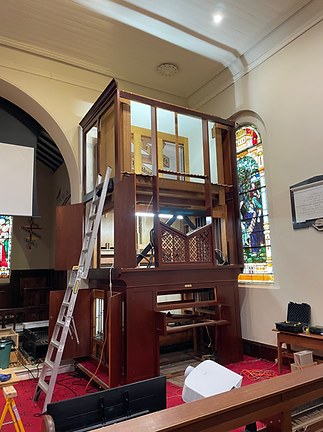
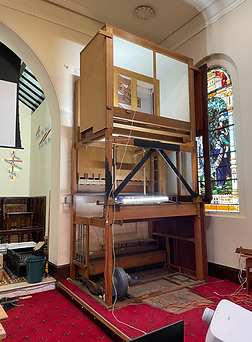
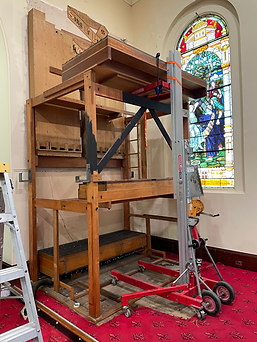
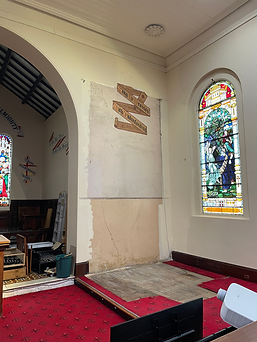
By the middle of the second week, all that was left was the main structure, three soundboards, swell box and the pedal bass pipes sitting against the wall. With the help of a 300kg capacity materials hoist, we made light work of what would have been a very difficult removal of the upper components. As pipe organs are dismantled they become more and more precarious as their supporting structure is removed. Being able to safely lift heavy components such as this from the safety of ground level with readily available equipment is a luxury that many organ builders wouldn't have had back in the day, instead relying on shear man power to get the job done.
Week 3 On-site at St Anthony Of Padua, Austral
With all components carefully transported to their new home in Austral, work could begin on the cleaning process prior to the reassembly of the instrument. Being of relatively modern construction with most exposed surfaces being polished, a good vacuum and clean with sugar soap was sufficient to remove the decades worth of accumulated dust and grime.
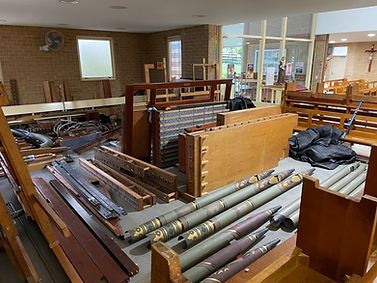

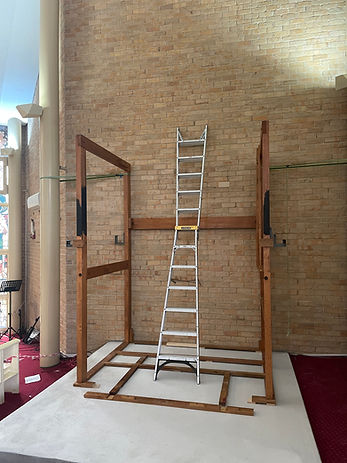
Once all the building frame components that form the main structure of the instrument had been cleaned, we positioned and levelled the base frame which provides a stable foundation for the organ. The two main side frames were then located on their footings before being tied in with horizontal rails. It was then time to install the two sets of "mouth organ" pedal bass pipes which are perched on the rearmost rail against the wall. These pipes are supplied with their wind via conveyance tubing from pedal soundboard below.

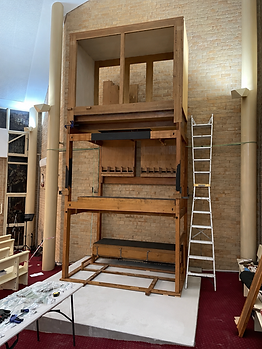

With the bass pipes installed and rest of the building frame rails in place, it was time to hoist the 200+ kg swell soundboard on to the upper rails of the structure, before surrounding it with the panels that form the swell box. Work then moved down to the bottom of the organ where we installed the pedal soundboard, the last of the three divisions.
Now that the main structure was complete supporting the bulky components, we began attaching the decorative hardwood casework. This transforms what is really a strong, rugged construction into a delicate looking piece of furniture that is in keeping with the interior of the church. With that said, the casework provides a significant amount of rigidity, which is very evident when moving around on the upper reaches of the instrument.
To finish a very productive week on-site, the side access panels were installed in their frames and the decorative mouldings were carefully fixed, ensuring seamless mitres and joins. The Eagle eyed may notice the missing finial from the top centre of the ornate. This very nicely turned piece of mahogany will be kept aside and installed on the final day to signify the completion of the project.

Week 4 On-site at St Anthony Of Padua, Austral
With the building frame, soundboards and casework assembled, work could begin on installing the upper boards on the soundboards. Before positioning and fixing them in place, it is considered one of the most important jobs in organ building to ensure the top of the soundboard is totally clean and free from debris. Any amount of foreign matter can cause resistance and binding during the operation of the stop action.

Before installing too many smaller components and creating obstruction, we set about reinstating the larger components of the mechanical action. Specifically, the three roller boards which serve the purpose of distributing the organists input at the console to the various departments of the instrument. From here, the wooden tracker linkages and pull downs can be installed, which will eventually complete the connection to the keyboards and the pedal board.


Week 5 On-site at St Anthony Of Padua, Austral
This week began with the thorough cleaning and installation of the key sets and the pedal board. Installing keys is a painstaking process which involves the intricate connection to the mechanical action and also the coupler chassis which combines the input of both manuals and the pedal board. Once the keys were in position, work could then begin on the final adjustment of the action. This important step ensures that every linkage within the instrument is under tension, so when the organist plays a note, his/her input is immediately transferred and performs the desired function.


With the keys and pedal board in position, the final few components of the wind system were installed. This allowed us to start up the blower and commence the first stages of testing.
During testing, we firstly eliminate any wind leaks in the system between the blower and the various departments of the instrument. We then move on to the soundboards and check that they are being supplied with the correct pressure of wind, this is critical for correct pipe speech and tuning.

Week 6 On-site at St Anthony Of Padua, Austral
A new week seen preparations made for the installation of the pipework. All metal pipes were put through a warm bath with a mild detergent to remove the decades of built up dirt and grime. This process is not primarily for aesthetics, but rather to enhance the speech and clarity of the tone that every pipe makes, clean pipes have the effect of a much brighter sounding instrument.
Wooden pipes are not spared during the cleaning process, tuning stoppers are removed and a warm damp cloth is sent down the pipe to remove dust.


Before the newly cleaned pipework can be installed in the instrument, a critical step must first be carried out in the organ. Despite great care and attention being paid to cleanliness during the assembly of the instrument, it is inevitable that some dust or debris can find its way in to the the air passages which carry the wind to every pipe. It is therefore crucial that we turn the organ on and play every note to blast out any debris. This reduces the possibility of dust being fed back in to the pipework after installation.
Pipework is installed rank by rank starting from the stop furthest away from the access passage boards. Before filling the soundboards entirely, we "rough" in to tune the installed pipework so we can identify any problematic pipes, this allows us to perform any voicing work on the pipes while they are still reasonably accessible. Once all pipework is installed, we can then start the final tuning and regulation process.


Week 7 On-site at St Anthony Of Padua, Austral
The final week on site at St Anthony's began with the final tuning of the entire instrument. This is followed by a few days of minor adjustments, debugging and final installation of casework before handing the instrument over to the client.
We thank the parish of St Anthony for entrusting us with this project and its ongoing maintenance. It brings us great satisfaction to give this fine instrument a new lease of life where it will become an integral part of the community and its worship.
